Search This Blog

Showing posts with label fascism. Show all posts

Wednesday, October 28, 2020

Responding to the Legacy of George Orwell


Dr Tristan Ewins


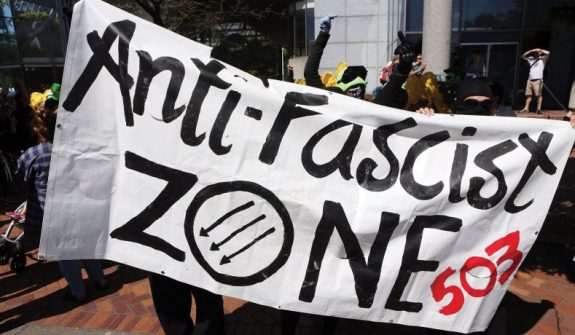
Just the other day I was a participant in a debate on George Orwell. One person argued that Orwell was opposed to Left Authoritarianism, and as a consequence would be opposed to ‘Antifa.’  (For those who don’t know, ‘Antifa’ is a broad anti-fascist popular front, often led by anarchists)  Another person responded by saying Orwell was really a social democrat, and spent his life fighting fascism.  Orwell is used to discredit the Antifa cause – in a process that is, well, ‘Orwellian’.


Both people were right in their own way ; but despite the problems with Leninism it is best not to get it entirely mixed up with Stalinism. (though they are historically linked)   Orwell himself was a socialist, and fought in Spain against Franco.  (with the POUM – which translates as ‘Workers Party of Marxist Unification’)   The legacy of George Orwell is too important to reduce it to a critique of ‘socialist totalitarianism’.  Yes, there is an anti-Stalinist aspect to ‘Animal Farm’ and ‘1984’.  But Orwell’s opposition to ‘totalitarianism’ is deeper than this ; and capitalism is increasingly portrayed as an ‘absolute’: ‘total capitalism’.


Tactically and in principle it’s also dangerous to avoid the use of the word ‘socialism’ by arguing for ‘social democracy’ instead.  By using both terms together we get a better sense that ‘socialism’ and ‘social democracy’ once meant the same thing.   (and perhaps could again)  ‘Social Democracy’ is more complex than just ‘the post-war mixed economy, Keynesianism and welfare state’.   And the original social democratic (socialist) tradition deserves to be rescued, despite Rosa Luxemburg’s insistence it had become a “rotting corpse” on account of its response to World War One. 

In truth, most of global social democracy did capitulate on the issue of the War ; and this was the flashpoint which saw the rise of Leninism and its opposition to the rest of the Left.  (importantly, Luxemburg herself was what we may call a ‘libertarian socialist’ and was critical of Leninism’s practice of ‘democratic centralism’ following the revolution as well)  Here we have to distinguish, also, between ‘democratic centralism’ as a mode of organisation prior to 1917 on the one hand, and what it mutated into later under Lenin ; and worse so under Stalin.  But figures like Julius Martov and Karl Kaustsky resonated with their criticisms of Bolshevism, also, and in so doing left a legacy for radical social democracy. (socialism)  And the Austro-Marxists and their so-called ‘Two and a Half international’ also stand as a reminder that there were alternatives between Leninism and Right Social Democracy.  For many years ‘Red Vienna’ was considered a model of radical (socialist) social democracy. It also involved a ‘workers army’ (Schutzbund) which was meant to be a ‘final defence’ for ‘the democratic path’.  Ironically,  it succumbed to an indigenous ‘clerical fascism’ itself because it could not decide how to fight ; or when; or where.  But Austria’s levels of high quality public housing are an enduring legacy as well.

When people criticise Leninism they often neglect that Leninism originally still allowed for mass participation in the Vanguard Party. (ie: a party of professional revolutionaries whose job it is to lead the revolutionary working class ; often under conditions of capitalist state repression)  There is also a tension, here, between the original ‘Vanguard’ role of these parties, and later gestures towards mass participation.  This goes to the question of whether a ‘one party state’ can be truly democratic. The answer depends on freedom of participation and organisation, and the absence of internal Terror.  Stalin went one step further than Lenin and imposed Terror WITHIN the Party and the whole of society. Up until after the Revolution Leninism allowed for factions as well.  


Terror is undesirable anyway, and tends to expand as centralism increases beyond a certain point.  Thus far, Rosa Luxemburg is correct in her critique of Leninism. The problem is that war and foreign intervention left limited choices ; and this helped lead to tragedy.


So it depends what you mean by Leninism. There's democratic centralism and the Vanguard Party. Following the Menshevist/Bolshevist split of 1903 (see: 'What is to be Done?' - it is the definitive text on Bolshevist organisation ; written in 1901, published in 1902)  And then there's certain policies which followed: Terror (first outside of, then inside of the Party as well – increasingly pervasive and indiscriminate), labour militarisation, banning of factions and of other socialist parties, and so on. The point is that Stalinism took all this to a different level ; and democratic centralism was originally predicated on freedom WITHIN the party (but discipline in between Conferences ; partly as a defence against state repression).

That said, there was a logic to Leninism, which in the context of Entente and other foreign intervention, civil war, the threat of starvation and of people freezing to death – helped lead eventually to Stalinism.  More and more extreme measures were taken (largely defensively) ; and led to permanent repression.

In contrast, though, I don't believe in Leninist centralism. One reason is that in certain contexts it means the suppression of debate between Conferences. I also believe it's inevitable factions will organise ; and forcibly suppressing factions just favours the ruling stratum. Finally, I share Rosa Luxemburg’s love of freedom, and recognise that while Leninism and then Stalinism resulted in certain ‘victories’, over the long term these resulted in an object lesson which was used to discredit the Left, and justify policies like McCarthyism. (anti-socialist hysteria and repression)

The problem is: What was the 'way out' in Russia at the time? A purely liberal response may have ended in White victory, a continuation of the slaughter of World War One, and Tsarist Restoration. Also remember that the Bolsheviks were the only Party willing to pull out of World War One pretty much unconditionally.  Maybe the solution was ‘dual power’ – with co-existence of Soviets, the Constituent Assembly and the Red Army.


Leninism - warts and all - has problems ; but remember the context of World War One, threatened starvation and social collapse as well. And the liberal parties wanted to continue that war.  Even the Left Social Revolutionaries took this approach - resulting in an assassination attempt on Lenin.


Remember that the French Revolution was bloody as well ; but the tactics of the Jacobins didn't forever discredit democracy or liberalism. By contrast we are constantly told that Leninism and Stalinism have forever discredited socialism.


Better to avoid the dilemmas the Bolsheviks faced in the first place - because it was bound to end tragically. But appreciate the moral complexity. The Russian Revolution came on the tail end of a War that killed over 20 million people. Some of the same people who are critical on Leninism will try and justify the First World War. And ignore the long list of Western Cold War atrocities. (for example, the brutal mass murder of half a million communists and labour movement activists in 1960s Indonesia)

 
Importantly: liberal democracy ultimately triumphed. But only because it was able to ‘tame’ and internalise the broad left within a practical capitalist consensus.  And eventually a virtual neo-liberal consensus.  Still: “liberal democracy” is worth defending as opposed to the alternative of Stalinism or a Corporatist State. (ie: fascism)  Now that it lacks opponents on the Left, we see liberal democracy attracting critics on the Right.   (so much for ‘The End of History – a term coined by the liberal Hegelian, Francis Fukuyama after the collapse of the Soviet Union) Here it is well to defend Liberal Democracy . At least it retains freedoms which make liberation imaginable ; and even its limited freedoms are preferable to the Rightist alternative)


Libertarianism of both the Right and the Left when authentically expressed are not as bad as fascism.  A true libertarian would defend the rights of unions and their workers to withdraw labour. And would treat free speech as a universal.  A fascist would work through a corporatist nationalist state that suppressed opposition violently, and promoted a literally illiberal Ideology.  By ‘corporatism’ we mean the forcible union of capital and labour under authoritarian state nationalism. (though certain variations on ‘corporatism’ – eg: Sweden – saw rather an institutionalisation of class struggle and the mobilisation of ‘Power Resources’)  A true Left libertarian would be sympathetic to the cause of ‘Antifa.’  A right-libertarian would accept their right to participate and exist. Personally, I consider myself a socialist liberal. That said, all organisations can be penetrated by agent provocateurs.  And ‘ultra-leftism’ is often mistaken.


Remember, also, Marx said of the bourgeoisie that it would 'snort' at its republic "Better end with Terror than Terror without End". (written in 1852, largely in response to the context of the 1848 Revolutions)  Trump understands this and seeks a predicate for repression based on 'law and order'. Agent provocateurs understand this also and act accordingly.  (‘End with Terror’ itself can also lead to ‘Terror without End’ under Fascism ; and Hitler came close to winning the Second World War at several points)

The Left needs to respond strategically.  We should not disavow militancy generally ; and practically disarm ourselves.  But neither should we support every act of militancy when this will result in our isolation.  There is a dilemma.  Rosa Luxemburg talked of “spontaneity of the masses” : a ‘dialectic’ between revolutionary working class self-initiative and the leadership of a revolutionary party.  In a way she is right.  On the other hand, unrestrained rebellion can work as a pretext for State Terror. Think of the rise of Mussolini and fascism in the 1920s in Italy following a period of revolutionary upsurge.


Also, under Stalinism Western Communist Parties were often restrained to further Soviet Foreign policy.  Dulling the class struggle.  But sometimes there is wisdom in restraint.

There is also wisdom in taking the initiative at the right time ; including militant strategies.  The Left needs to be nuanced enough to know the difference.


This article was originally published at ‘The Australian Independent Media Network’

Saturday, January 10, 2015

Andrew Bolt on ‘Charlie Hedbo’ and Free Speech: A Response


The arguments about free speech are often complex.  But freedoms and liberties must be defended
 
Tristan Ewins, Jan 11th, 2014

Andrew Bolt has fired another salvo against the Australian Left (Heald-Sun, Jan 10th 2015); this time accusing the Left – and what he ironically calls ‘the ruling classes’ of this country – of ‘giving in’ in the face of Terror.  He argues that the French satirical publication ‘Charlie Hedbo’ was “almost alone” and that this emboldened the killers.   He argues that ‘the Left’ is hypocritical in the sense of constantly satirising, attacking and mocking Christianity – while claiming Islamophobia in response to critiques of Islam.  For Bolt censorship and self-censorship mean ‘the Terrorists have won’.   Bolt also condemns the racial vilification laws which he claims led to the ‘banning’ of two of his articles.  Bolt complains of ‘mainstream’ journalists ‘celebrating’ this decision; though surely this is a bit ingenuous given his claim to be ‘Australia’s most read columnist’.      He also attacks Australia’s migration program in so far as it welcomes “mass immigration from the Third World”.  Finally he claims Islam’s claim to be ‘a religion of peace’ is false in light of Koranic scripture urging the deaths of those who mock the Prophet Muhammed.   

Where do we start in responding to Bolt?  

On the matter of Left hypocrisy I personally sometimes cut a lone figure in requesting respect and sensitivity towards the Christian faith in the face of sometimes-hateful attacks.   The Christian emphasis on ‘turning the other cheek’ perhaps suggests a certain acceptance even in the face of criticism.  Rational (not hateful) criticism, indeed, is welcome – and has informed a shift in Christian thinking over recent decades to made an accommodation with liberalism.  Though in earlier centuries some church leaders were complicit in repression and Terror.  

There are liberal Muslims just as there are liberal Christians.  Though in the West liberal Christianity is more prevalent. There are relatively rare Christians who still advocate an unreformed interpretation of Scripture. But most today have turned from ‘Biblical literalism’ in areas such as Creationism for instance.  (instead Genesis is held by some  to be a parable containing a mystery which few understand; Though this should not mean we close our minds to the prospect of mysteries as yet not understood – for instance free will and consciousness itself)

The shift towards liberalism; of ‘turning the other cheek’; and the rejection of literalism has moderated what social conflicts may have arisen between liberalism, secularism and Christianity.  These tendencies in Christianity reveal  the falsehoods in many hostile caricatures of the faith.  We have had ‘Piss Christ’ and ‘The Last Temptation of Christ’, and yet many Christians accept that even while this may be hurtful, it is part of the liberal pluralist order we live in.

But where does Islam stand?   Just like there is liberal Christianity and Reform Judaism, also there are liberal movements within Islam.  There have been attempts to moderate the message of Islam.  Greater gender equality is promoted as well as pluralistic and individual interpretations of the Koran.  There is respect for democracy and human rights; slavery is rejected.   Yet arguably if one looks around the world today, both Shia and Sunni regimes – from the Saudis to the Iranians – these regimes have been reticent in adopting a liberal/reform orientation.   There are barbaric instances of corporal and capital punishment; women are often second class citizens; sexuality is stigmatised. Yet in a throwback to an earlier time self-proclaimed Christians in Uganda have sought to criminalise homosexuality as well – with potential life sentences for those practicing their sexuality.   

In response to Bolt it is fair enough for a democracy to hesitate before welcoming any who do not share basic precepts when it comes to liberal and human rights.  To welcome refugees is an exception – as there is the global responsibility to provide refuge for the persecuted.  And often the wars which refugees flee are proxy conflicts – the consequence of ‘Great Power’ interventions. 

It ought be noted that in the past similar arguments have been deployed to prevent communists and other left radicals from being accepted into our society. But while in the past many were deluded about the reality in ‘really-existing’ communist regimes, their orientation was nonetheless progressive when it came to defending liberal rights at home; as well as the rights of women, indigenous peoples, those of queer sexuality, the industrial liberties of workers and so on.  But anti-modernist radicals – whether they are Sunnis from Saudi Arabia, Shia from Iran, or Christians from Uganda – pose a potential threat to liberalism if ever their challenge to Modernity reached the critical point.  That is for example in Australia: if ever they comprised so formidable a bloc as to hold decisive political and cultural leverage

Against this – Despite some peoples’ over-blown fears, those of Islamic faith comprise only two per cent of the Australian population.  And well-intentioned engagement between liberals and Muslims could result in many more Muslims shifting into the liberal camp. Much as occurred with Christianity.  An uncontrolled influx could change this; but that is not the situation.

Yet that engagement is threatened by the ‘culture war warriors’ who would preach a message of civil conflict on religion rather than engagement.  Bolt is sceptical of Muslims claiming that theirs is ‘a religion of peace’.  But we would do well to remember it was not all that long ago that religion was cited as a rationale and a justification for centuries of colonialism and Imperialism of various European Great Powers.  Today strategic interventions and proxy wars are also justified on the basis of liberal and democratic Ideology.  But beneath the surface a more complex picture emerges.  Great Power bases in Syria and Qatar; fears over an Iranian bomb; attempts to isolate Iran through destabilising its Syrian ally (with over 200,000 dead!); the Syrian intervention backfiring with the rise of Islamic State – and yet even Islamic State could be could be seen by some as a counterbalance to Iran in the region. It is often very cynical. (the previous balance of power was wrecked through George Bush’s Second Gulf War, which ironically for the time was supported by Israel).

Finally we come to Bolt’s cries of censorship.

Censorship is a difficult question, and interestingly today it is self-proclaimed right-libertarians who advocate unmitigated and unmoderated free speech in the face of suggestions from others on the Left that speech be regulated – whether through state interference in the monopoly mass media, or through enforcing stronger racial discrimination laws.  

There is a lot to be reviled in the American settlement when it comes to their threadbare social security and welfare safety net; the neglect and rescission of workers’ liberties; oppressively low minimum wages; tolerance of homelessness on a mass scale…  But despite the hypocrisies of McCarthyism in times past for instance, ‘free speech’ is enshrined in the American Constitution and as part of American identity.  This notion of ‘absolute’ and ‘inalienable’ rights gives the far right conditions under which they can organise.  But it also provides a vital protection for the Left which could be utterly crucial, perhaps, in the future.  Without the argument of ‘free speech’ Doc Evatt would most certainly have failed in his defence of the liberal rights of Australian Communists.

In Australia we face similar dilemmas.  Andrew Bolt’s comments about indigenous Australians were hurtful, offensive and I believe they were cynical. Indigenous identity is about more that the colour of ones’ skin.  And preferential assistance through Abstudy, for instance, is intended to ‘close the gap’ when it comes to educational opportunity. Arguably ‘Closing the Gap’ needs to be a core aspect in a future Treaty.

Though Justice Bromburg, who decided on the Bolt case, insisted that he was not banning Bolt from sincerely debating the issue of indigenous identity.  And Bolt-critic Chelsea Bond argued that Bolt was not actually a racist.  Yet Bond argues that Bolt’s approach: “reveals his own anxiety toward the dilution of the 'coloniser's' identity, power and privilege.”   Bolt was exploiting these anxieties for cultural and political gain; and to this author therefore his endeavours were cynical in nature. 

There are important arguments here – for instance the need for a cultural settlement which reconciles the plurality of Australian identities – including that of pre-multi-cultural and Anglo identity and culture – as a means of ‘heading-off’ grievances, far-right organisation and irrational conflicts into the future.  (Although there never was a ‘mono-cultural’ Australia; and a past-world of Anglo/Irish tension is forgotten now by many)  Rejection of an ‘older’ Australian identity could drive many into the arms of the Reaction.

But should Bolt’s cynical comments have literally been BANNED? Certainly Bolt himself appears intolerant of any place for radical progressive speech in this country. His depiction of the ABC as a mouthpiece of the Left plays up to a now familiar Right-discourse around supposed Left-cultural-elites’ versus ‘the ordinary people’ – ‘the masses’.  This perspective was developed by Constitutional Monarchist and Conservative David Flint.  It is intended to remove any and almost all space available for the ‘genuine Left’ to be heard.   The ABC appears to feel it needs to prove ‘it is not radical’.  And at the same time the ABC increasingly leans towards ‘Centrist’ and ‘Centre-Right’ commentary.

This discourse on ‘Elites’ is deployed in order to play to cultural anxieties; while at the same time downplaying the class interests of the great majority of working people, as well as the marginal and the working poor.  American author Joe Bageant has compellingly written in his “Deer Hunting with Jesus” book how in the United States how ‘the white working poor’ are increasingly propagandised by right-wing Ideology; and how this process is inflamed by ‘class based putdowns’.  (indeed: we could also raise such language such as ‘white trash’ – which at once vilify on the basis of class AND race)  American liberalism’s de-prioritisation of social class as an unifying issue inflames the problem further; and the Labor Party in Australia might be seen as falling into a similar trap. 

The answer is not to ban conservative speech. Though perhaps there are exceptions such as Holocaust Denial – which could lead to ‘a culture of forgetting’ – and in the long term even a rehabilitation of fascism. (or even fascism’s worst historical manifestation, Nazism)  But every time we make an exception to free speech and weaken its absolute nature we potentially provide our enemies the very weapons that could be turned against us into the future.   Also – while perhaps an impossible ideal, Jurgen Habermas’s ‘Perfect Speech Situation’ is such an ideal as to be worth questing after in many respects.  Along with pluralism and acceptance of mediated conflict engagement is also a potentially core-foundation for liberal democracy. 

The problem is that on the Left we simply do not have the resources to be heard and considered alongside the cacophony of right-wing viewpoints.  So we are far from a ‘Perfect Speech Situation’.  Censorship is not the answer;  but the articulation of a broad new historic bloc is.  What is needed is a united front against domination and injustice.  That is to mobilise the necessary resources to bring about what Austrian Social Democrats once called ‘growth from within’ – but on a broader basis -  amidst disciplined solidarity.  There is scope for ‘asymmetrical cultural struggle’ with the rise of the internet.  But also a need to promote REAL pluralism via public and community media; involving an inclusive exchange across the entire spectrum – save for the far right.  The same inclusive pluralism must guide reform of school curricula also.

But none of this demands the silencing of Andrew Bolt.  Rights might not be absolute – especially in the midst of extreme circumstances.  But we all have a duty to avoid the escalation of civil conflict to the point where brute repression and Terror become reality. We can challenge Andrew Bolt without banning his speech.  And we can show solidarity with Charlie Hedbo by confronting the associated issues openly and open-mindedly – but avoid an escalation of rhetoric which would only polarise our society along religious and ethnic grounds.  And we must learn the lessons of past interventions – for instance in Iraq – which created the conditions for the war in Syria, and also the rise of the Islamic State movement.

Finally – without supressing speech – a discourse on ‘responsible’ speech should aim to avoid language of extreme escalation and polarisation on the grounds of religion or race. 

We must be uncompromising in defending rights of speech, assembly, association, conscience, as well as other liberties. (eg: industrial liberties)  The mass rallies in France and Australia demonstrate that Charlie Hedbo is now far from alone: Hundreds of thousands have mobilised to support free speech; and to reject intimidation through Terror.

But ideally freedom should be balanced with honest self-criticism. This may seem to go ‘against the spirit’ of Charlie Hedbo.   But it might be a precondition for the engagement which could promote long-term harmony between religion and liberal rights in this country.