Search This Blog

Wednesday, February 3, 2021

A Zionism of Mutual Recognition and Hope: Reconsidering Judah Magnes


                                                  above:  Judah Leon Magnes


Dr Tristan Ewins


In today’s ‘modern Left’ ‘Zionism’ is often taken as a term of abuse.  The oppression and dispossession of the Palestinians is widely seen as negating the very right of the ‘Jewish State’ to exist.  Judah Magnes himself is commonly dismissed in modern Zionism as a ‘destructive and naïve influence’.  (we will discuss these claims at some length)   But Magnes’s legacy ; as well as the legacy of others such as Hannah Arendt and Martin Buber ; show “another kind of Zionism is possible”.  On the other hand, modern anti-Zionism is itself at best naïve in believing that the defeat of the Jewish state would lead to a secular, democratic, pluralistic and inclusive Palestine.  There is  a cycle of revenge and Terror going back from  before Israel’s formation, and to the current day.  Modern right-Zionism (including in the Revisionist legacy of Likud ; which follows after the Irgun Zionist faction) presumes that conciliation is impossible ; that only Israel will stand for its own interests ; and that political and military ruthlessness is the only road to survival.

Though his binationalism is often held by dissenters in opposition to modern Zionism, it is forgotten often that Magnes himself was a Zionist.  Raised in the United States, Magnes adopted a pacifist posture during the horrors of World War One.  He also adopted what he saw as American ideals of democracy and pluralism.  But Magnes also came to oppose assimilation in the US amongst Jews most strongly. Though he was later identified as a liberal Reform Rabbi, he was Conservative in the sense of holding strongly to Jewish tradition and a strong Jewish identity.  His compromise position became known as 'cultural Zionism'.  (Kotzin, p 119)  For Magnes a pluralistic US could accommodate Jewish nationalism (Zionism) within a broader national identity.

As Daniel P.Kotzin argues:  “His “progressive” “Zionist ideal” reveals “a larger agenda”. Hence: “Magnes was trying to fashion American Jews as an ethnic group wherein diversity  was possible within a construct of Jewish solidarity.”  He “forged” “an ethical-liberal Zionist ideal” based on “his cultural Zionism, Reform Judaism and American progressive ideals that combined ethical universalism with Jewish particularism within a pluralistic framework.”  Magnes wanted Arab “national autonomy in equilibrium with Jewish national autonomy.”  (Kotzin, pp 5-6)    

But in his eagerness to preserve Jewish identity, Magnes had sympathy for the Orthodox position as well.  Indeed, Magnes openly embraced Zionism at a time when many Jews in America were not willing to make the same leap.  Importantly, Magnes came to support the ‘Jewish Defence Association’ (JDA) which aimed to arm Jewish communities to defend against pogroms and the like.   (Kotzin, p 66)  He tried to embrace Chanukah as a celebration of Jewish nation-hood.  He also embraced the teaching of Yiddish as part of a “cultural Zionist program”  which actually promoted unity instead of fragmentation. (Kotzin, p 73)

Specifically, Magnes supported a Jewish national home in Palestine as opposed to proposals for elsewhere – like Uganda.  But importantly,  he felt it was essential to come to an understanding with Palestine’s Arab residents ; to consult with them and arrive at a kind of co-determination.

Rather than pure majoritarianism, Magnes promoted ‘deliberative democracy’ within the broader Jewish community as the road to unity.  His perspective of ‘equal opportunity’ extended to Arabs in Palestine ; and for him a large Arab community there had to be accepted and worked with.   (Kotzin, pp 135-140)

During World War One Magnes defended civil liberties and free speech in the context of his pacifism.  He also came to oppose the ‘Red Scare’ following the Bolshevik Revolution.

Following World War One, the Balfour declaration – establishing a Jewish national home in Palestine – heightened tensions between Jews and Arabs.   Arabs launched anti-Jewish riots in Palestine.   Some Zionists thought Jewish migration would bring benefits to Arab society and thus would eventually be accepted.   But the Zionist Organisation of America held that “the land, natural resources and public utilities would be owned by Jews, and all schools would be conducted in Hebrew.”  By contrast Magnes interpreted Jewish ethics as “radical pacifism”.  (Kotzin, pp 155-156)   He only reconsidered this uncompromising pacifism in the context of World War Two and the threat posed by Hitler.

Again, Magnes’ position on ‘national self-determination’ translated as co-determination between Jews and Arabs in Palestine.  For Magnes:  “[the] very prestige and reputation of the Jewish nation, which presented itself as liberal and ethical, depended on this.” 

Upon migrating to Palestine, Magnes was appointed as Chancellor of the Hebrew University which was being established there. 

The Faculty of Humanities opened in 1928.   Magnes also promoted the teaching of Yiddish language and culture ; though conducted in Hebrew. He thought it was important to be inclusive while establishing Hebrew as the national language.   But many protested - finding Yiddish a threat to Hebrew culture.  Magnes wanted the Hebrew University to be inclusive of all Jewish culture – ancient and modern. (Kotzin, p 194-196)

The British tried to appease both Jews and Arabs ; and in the 1920s said they had no intention of creating a Jewish State.  Transjordan was established in an appeal to Arabs. Arab resistance was minimal by 1924.

BUT critical of the other Zionists’ willingness to compromise  with the British, the controversial Zionist Vladimir Jabotinsky resigned from the World Zionist Executive in January 1923. Jabotinsky recognised the existence of Arab nationalism, but he believed Jews had a moral right to Palestine.  Declaring a maximalist Zionist objective, he demanded a Jewish State that included Transjordan. According to him, Arabs must accept the inevitability of Zionism. Once they did they could live peacefully with Jews in a Jewish State.”  Jabotinsky called his new movement "Revisionist Zionism”.  (Kotzin, p 197)

In response, “Arthur Rippon, a member of the World Zionist Executive who was also active in the expansion of Jewish settlement in Palestine, presented a program for a Binational Palestine at the 1925 Zionist Congress. He argued that Jews should work with Arabs to obtain their consent to the Zionist movement rather than engaging in an endless conflict.” (Kotzin, p 197)

Hans Kohn and Robert Weltsch, students of Martin Buber – along with their mentor – believed co-operation with Arabs could be achieved by renouncing any exclusive claim to Palestine.  They believed in a Zionism based on ethics and justice that “transcended mere political aims.” An organisation called “Brit Shalom” (Covenant of Peace) was established.  Magnes built relations with the members of Brit Shalom.  Though he did not join. (Kotzin, p 198)

With the rise of Nazism in Germany Magnes feared  that Jews were threatened with “Systematic extermination”. He wanted the University to be a refuge for Jewish scholars. (Kotzin, p 213-214)

But as a binationalist, Magnes was willing to let go the dream of a Jewish State for a reality of liberal democracy ; where Palestine was ‘the Jewish national home’ ; but where Arabs and Jews lived and governed together as equals.  He believed in the Israeli nation’s “ability to act as a moral and liberal beacon for the world.”  And he believed Arabs and Jews should actually support and assist each other in their national aspirations. Though secretly, Magnes feared Arabs would stop Jewish migration outright if given the chance.   (Kotzin, p 220, pp 226-227)

Magnes enunciated “three conditions” as a framework for Zionism in Palestine: “the right for Jews to immigrate to Palestine based on the country’s economic absorptive capacity, the rights for Jews to buy and sell land in Palestine, and the right for Jews to build their own cultural and religious institutions in Palestine.” (Kotzin, p 224)

But as Kotzin explains:

 “such views had little meaning for the Zionist leadership, and in their eyes had no tactical merit.”  “They viewed him as a rogue American Jew, one who could have dangerous influence because of his connections but who acted recklessly, without respect for official bodies like the Jewish Agency and without consideration for the political consequences of his actions.”  (Kotzin, p 221)

In 1928/1929 there was an Arab/Jewish dispute over the Western Wall.  This led to Arab attacks on Jews. Over a week 133 Jews and 116 Arabs were killed, and many others wounded.  Labor Zionists made comparisons with pogroms in Russia. Most rejected the need for Jewish/Arab co-operation. (this was seen as unrealistic) As Kotzin explains: “Jews who called for peace and understanding, like the members of Brit Shalom, were condemned on the streets of Tel Aviv and Jerusalem in the belief that they demonstrated Jewish weakness, not Jewish strength.”  (Kotzin, p 222)

P 233   “[Chaim] Weizmann, while sympathetic to Magnes’s ideas, found his political tactics problematic. Magnes ignored the fragile political situation” and hence could “damage…the Zionist project.”   He believed “Arab intransigence” made it “impossible  to negotiate with them.”   He accused Manges of “breaking our united front”.  Some Arabs tried to play Magnes off against other Zionists, depicting the others as “extremists”.  (Kotzin, p 233)

Stephen Wise also feared Magnes was turning liberal opinion against Zionism in the US.  Zionists were worried at the prospect of democratic institutions before there was a Jewish majority.  But moderate Opposition Arabs within ‘the Arab Executive’ had long favoured co-operation with Jews and wanted to defeat the Grand Mufti (of Jerusalem) – who was to go so far as to collaborate with Hitler. (Kotzin, pp 234-235) 

The rise of Hitler in Germany accelerated Jewish migration into the tens of thousands – over 66,000 in 1935.   By 1936 Jews were more than one fourth of the population in Palestine.   Arabs feared this ; including migration and land purchases ; but turned most of their anger against the British.  Meanwhile Revisionist Zionists promoted a hate campaign against Ben-Gurion and the Labor Zionists for their willingness to negotiate with the Arabs.   David Ben-Gurion now felt the improved Zionist position would force Arabs to the table.  Revisionism began to retreat at this time as well. (Kotzin, P 247-248)

But Ben-Gurion still had an end objective of a Jewish State as opposed to Magnes’ ‘Binational’ state.  

Magnes was desperate to make a difference.  In negotiations Magnes was interested if Arabs would be willing to compromise on Palestinian Arab national aspirations for the sake of broader Pan Arab aspirations. (pp P 250 -251)

Magnes and the Partition Plain

During 1935-37 the British developed a partition plan ; to partition Palestine and Transjordan between Jews and Arabs.   Some thought the proposed Jewish State was too small ; but for Ben-Gurion the prospect of sovereignty was appealing.  American Zionists led by Stephen Wise opposed the plan as the proposed Jewish State could not absorb all Jewish migrants – it was too small.   For his part Magnes was partly sympathetic – but feared partition could sow the seeds of future war.   Magnes came around to Felix Warburg’s anti-partition perspective. (Kotzin, Pp 259-260)

Instead Magnes proposed “a binational state” to the Jewish Agency – as an alternative to partition.  He “believed that he could make Zionist discussions about democracy and establishing solidarity with the Arabs.” (Kotzin, P 261) 

He feared if Zionism neglected the importance of “consent” it would become “oppressive”.   Ha-Kibbutz Haartzi shel Hashomer Hatzair (“The Country-wide Kibbutz of the Young Guard”) accepted the principle of binationalism, but under conditions of a Jewish majority.   They believed worker solidarity could overcome Arab-Jewish conflict.  (Kotzin, P 262)

While Magnes focused on Jewish-Arab relations he was also strongly concerned in the mid to late 30s with the situation of Jews in Europe and especially Germany.  He came to the view that Jews must free themselves from dependence on Britain because Britain was susceptible to Arab influence for strategic purposes at their time of greatest need.

Jews attempted to subvert British immigration restrictions.   Magnes became a mediator between the Haganah (an organisation of Jewish self-defence and illegal immigration) and the British.   Despite his pacifism Magnes supported WWII as ‘a war for humanity’. He said “the incarnation of the Devil sits on the German throne.”   When pressed hard he chose “the preservation of the Jewish people over his pacifist ideals”. 

In the midst of World War Two Magnes combined with over a hundred other like-minded individuals to form the ‘Ihud’ (‘unity’  or ‘union’) organisation – which favoured a binational solution as opposed to partition.

Progressive Zionists wanted to find a solution “that would open up Palestine for European Jewry but would not infringe on Arab rights.”   Many who were already sympathetic to “the notion of a binational Palestine” “became more overt supporters” of Ihud ; though others didn’t want to be linked with Ihud “in the public mind”.   By 1942 most American Zionists believed free migration and a Jewish State in Palestine had become necessary.  (Kotzin, p 294) 

But after the war Magnes did not endorse the offensive (military and terroristic) strategies against the British.  He opposed “offensive violence”.   Following the Holocaust many Jews demanded control over Jewish migration to Palestine, but Magnes believed a peaceful Palestine was better for Jews in the end.    (Kotzin, pp 274-276)   In short, the Holocaust changed everything ; and linked the creation of a Jewish State with an existential question of Jewish survival.  Magnes’ binational vision was progressively sidelined. 

Magnes was in the end proven correct that partition and a ‘Jewish State’ would lead to war.  But the Jewish State managed to survive regardless. However, the Yom Kippur war of 1973 demonstrated that Israel’s security was in some ways still precarious ;  and should Israel lose any broader conflict with Arab nations Jews would probably be treated no better than Arabs were treated with the Palestinian ‘Nakba’.  (the displacement of hundreds of thousands of Palestinians)

Leading up to the creation of modern Israel, Kotzin explains how:

 “Whereas [Magnes] was previously portrayed as a fool, now he was characterised as an ‘anti-Zionist’, a traitor to the Jewish people and the Zionist cause.”  Hevdah Ben-Israel thought he “was a traitor advocating an insane idea.”  “Zionists increasingly insisted  that the very existence of the Jewish people depended on acting with power and strength, which would be undermined by compromise.” (Kotzin, p 288)

Kotzin explains how both Arab and Jewish leaders failed to back binationalism in practice. “Magnes’s Reform Judaism and Buber’s religious socialism both emphasised that religious morality must influence politics.”  “They hoped Ihud would introduce moral and ethical values into the politics of the Arab-Jewish conflict.”  Magnes suggested a universalism based on a “Strong Jewish identity” ; while Buber claimed the Jewish nation had a “supernational task” of becoming “a true people” by submitting to God’s demands of “truth and righteousness”.   “According to Buber, Jews will be a “humanitarian nation” if they say “we will not do more injustice to others than we are forced to do in order to exist. Only by saying this do we begin to be responsible for life.”   (Kotzin, pp 297-299)

Magnes was convinced there was an Arab constituency for peace – but that they were cowed by ‘internal Terror’.   Together with others like Martin Buber and Hannah Arendt he attempted to form a ‘loyal opposition’ to the mainstream Zionist position from within Zionism.  Towards the end of his life, Magnes continued to promote federalism as a solution to the conflict.  He was glad to see a national home for the Jews created with Israel’s declaration of Independence ; but was deeply troubled by the displacement of hundreds of thousands of Arab refugees.  Sadly, while he had spent a great deal of time in the old Palestine, he passed away outside of Israel and never set foot in the newly created state.

In the 1940s Magnes lost support because “he failed to understand…that the Arab-Jewish conflict was no longer [considered the] primary concern.”  (instead the focus shifted to the Holocaust, Nazism, refugees)   Kotzin concludes that “by not focusing on the best means to help Jewish refugees, he failed to sell the binational plan.”

Today, though, a two-state solution seems a long way away. Jerusalem is united ; and Zionist leaders loathe to consider significant compromise. It seems there may be ‘one Jewish state’ ; but without meaningful co-determination or mutual recognition between Jews and Palestinians. But with the Two State Solution retreating, the project of One State based on co-determination deserves serious reconsideration. Today - with the rejection of Zionism on most of the Left – it is easy to forget that those such as Magnes, Arendt and Buber were also Zionists.  Jewish security could be preserved with a monopoly on the apparatus of force ; but with structures of self-governance and identity for both Jews and Palestinians beyond that.  For instance, Arabs have always been at the margins of Israeli democracy.  That needs to change in a binational state which is at the same time a safe haven and Jewish National Home.  ‘Deliberative’ and inclusive democracy as the way forward.

And the Israeli Left needs to become a voice for co-existence and co-determination over the long term. 

Magnes stands as an example which demonstrates for the broad Left that not all Zionism ought be ‘tarred with the same brush’.  Hence “Zionism” ought not be a ‘term of abuse’ on the Left. Though the obstacles are great ; with cautious hope the kind of mutual recognition and coexistence imagined by Magnes may still prevail over the long term.


Bibliography:

Kotzin, Daniel.P , ‘Judah L.Magnes – An American Jewish Non-Conformist’,  Syracuse, New York, 2010

Loewenstein, Anthony ; ‘My Israel Question’ ; Melbourne University Press, Melbourne, 2006

Warburg, James.P , ‘Crosscurrents in the Middle East’, Gollancz, London, 1969

Saturday, November 7, 2020

Democrats need to Galvanise the Working Class to Ensure Future Victories


above: Court Appeals aside, a Biden-Harris victory now seems certain 


 Dr Tristan Ewins


As a Biden-Harris victory becomes apparent in the United States Presidential race it’s well to consider the various stratum  of voters and how they have determined the result.  The future is still in question. Although Trump has lost, voters came out for both tickets in record numbers.  The Democrats need to sustain their current base, and indeed improve upon it in the future. There’s the question of how the Democrats might in the future do even better and win control of Congress as a whole, including the Senate.  At the moment policy gridlock is a real prospect.


Despite Trump's loss people are now speaking of the white working class as if it is a 'natural' Republican constituency.


In a way the Left in the US let this happen. Not only did the white working class turn away from the Democrats ; the US Left turned away from the white working class as well. Today class is seen as secondary to racial, sexual and gender identity.


In reality all of these things matter and the Left needs to build a united front.  But be careful telling a white working class man on minimum wage how privileged they are. Intersectionality needs to be more complex and nuanced.  We need to do more than just stacking a number of identity categories on top of each other. Rather we need to look at specific individual circumstance. The working poor – whether black, latino, white - are not 'privileged' in the big picture.  We also need to look at the social and economic ‘structure’ (ie: patterned social relations) , and the strategic position of the working class in this.


Another problem is the myth of the US 'middle class' ; standing in the way of solidarity between workers more broadly. The US class structure locks the working poor in place to support the consumption of middle income Americans ; but leaves 'middle income' Americans insecure enough to be vulnerable industrially. (the old reserve army of labour again ; with lack of labour market regulation and industrial rights ; and a lack of a ‘social safety net’ as well) We need solidarity across the whole working class ; against the top 10% - the rich and elements of the self-interested labour aristocracy. 'Middle income' is not the same as 'middle class'.


Again we need to emphasise solidarity across the whole working class ; but I think the privilege of working poor white people can be exaggerated. Race, gender and sexuality are seen as more important in determining privilege than class.  Again: In reality it all matters. That said, black people have problems with the police which white people don't have. Men don't have to worry about reproductive rights. There's still homophobia out there. But it's not helped when some people talk of 'poor white trash' and so on. The Right understands the meaning of 'divide and conquer', and the Left should not fall for it.


 I'm not saying ignore sexuality, race and gender. I'm saying what we are doing to a large extent is ignoring class. I'm saying we're hurting ourselves electorally and culturally by not attempting to mobilise the working class as a whole. I'm saying you should not just write someone off because they're a white male. And our language should reflect this. They could be working poor, unemployed, disabled and so on. Or they could just be working class ; which is the layer with a broad enough and strategically placed base to potentially transition from capitalism.


I'm saying we should also look at peoples' individual circumstances when working out privilege. The New Social Movements arising from the 60s onwards are a crucial constituency, and reinvigorated the Left in many ways. But the fact is workers are still alienated, imiserated and exploited under capitalism. And the fact is the American Left needs a strategy to win back white workers - not because they're more important in of themselves ; but because the working class is stronger when united ; and there's an important (and sizeable) constituency which can be the difference between victory and defeat.  


For instance, there is the US Senate where a Republican majority could potentially stymie meaningful change.  A stronger electoral showing could overcome this.  Race, sexuality and gender are important ; but we can't allow them to become all-encompassing fault lines. Again ; it's about divide and conquer. Don't let it happen. So don’t 'write people off' because of identity categories. Take each person as an individual.  The point is many workers are voting Republican and they shouldn't be. What's gone wrong here and how can we fix it?


Some people are trying to pin the blame on ‘academic elites’ ; with ‘Critical theory’ and ‘Cultural Marxism’ depicted as alienating the working class. But critical theory is diverse. Habermas is less about 'identity' than Marcuse. While Habermas looks at 'Legitimation Crisis' stemming from attacks on the welfare state, Marcuse looks to New Social Movements to 'fill the vacuum'. The problem is that the working class as seen by Marcuse in the 1960s is not the same as today's working class. Today's working class has not been 'bought off' by prosperity ; but is highly exploited and alienated. In particular there is job insecurity, a weakened labour movement, and a falling wage share of the economy. But a 'popular front' of working class and New Social Movements is the only way to win today. So the Right pays great attention to dividing us against one another with narratives on ‘political correctness’ and the like.  The Left needs a narrative which engages with more socially-conservative workers while not compromising on principle.


In Australia we don't campaign effectively on class either. We need to make peoples' economic self-interest transparent. If we could do that we wouldn't have to worry so much about "aspirationals".


Looking at how many votes Sanders got the liberals still do need the socialists in the Democratic Party.  (and vice-versa)  Biden's victory is largely because the Left base turned out. This needs to be impressed upon Biden so that Biden makes it a top priority to deliver on policy.  An active industry policy creating new manufacturing jobs – especially in ‘rust belt’ states – could be offered in return for health reform (a public option) and a $15 minimum wage. (indexed) If the Republicans refuse to come to the table here they turn their backs on the working class constituency the Democrats must try and win back. So perhaps they will be open to a compromise favouring the Democrat policy agenda. And then the Democrats can take credit for the policy as well.


Antonio Gramsci talked of a ‘counter-hegemonic historic bloc’ ; an articulated alliance of forces – including the organised and conscious working class ; and ‘organic intellectuals’ embedded in that class – as the key to socialist transition. To this today we must add the New Social Movements.  A counter-hegemonic historic bloc must include the broad working class ; and if meaningful progress is to be attained the Left cannot allow large swathes of that class to remain feeling alienated from, and over-looked by the Left.  


In short, this means appealing to the working class as a whole ; and emphasising class at least as much as race, gender and sexuality.  It means not allowing a critique of race and gender to prevent us from identifying class-based disadvantage.  It means not "writing off" white male workers because of race and gender ; but rather applying a nuanced intersectionality which appreciates peoples' unique circumstances.  And building solidarity based on this inclusive approach.

Wednesday, October 28, 2020

Responding to the Legacy of George Orwell


Dr Tristan Ewins


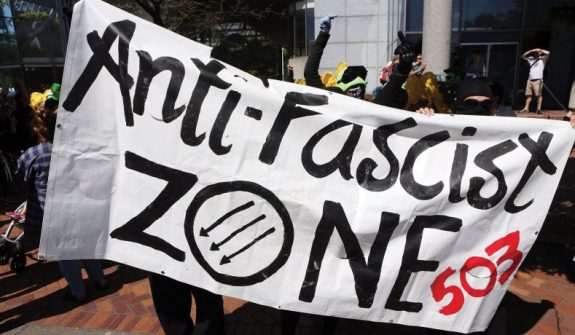
Just the other day I was a participant in a debate on George Orwell. One person argued that Orwell was opposed to Left Authoritarianism, and as a consequence would be opposed to ‘Antifa.’  (For those who don’t know, ‘Antifa’ is a broad anti-fascist popular front, often led by anarchists)  Another person responded by saying Orwell was really a social democrat, and spent his life fighting fascism.  Orwell is used to discredit the Antifa cause – in a process that is, well, ‘Orwellian’.


Both people were right in their own way ; but despite the problems with Leninism it is best not to get it entirely mixed up with Stalinism. (though they are historically linked)   Orwell himself was a socialist, and fought in Spain against Franco.  (with the POUM – which translates as ‘Workers Party of Marxist Unification’)   The legacy of George Orwell is too important to reduce it to a critique of ‘socialist totalitarianism’.  Yes, there is an anti-Stalinist aspect to ‘Animal Farm’ and ‘1984’.  But Orwell’s opposition to ‘totalitarianism’ is deeper than this ; and capitalism is increasingly portrayed as an ‘absolute’: ‘total capitalism’.


Tactically and in principle it’s also dangerous to avoid the use of the word ‘socialism’ by arguing for ‘social democracy’ instead.  By using both terms together we get a better sense that ‘socialism’ and ‘social democracy’ once meant the same thing.   (and perhaps could again)  ‘Social Democracy’ is more complex than just ‘the post-war mixed economy, Keynesianism and welfare state’.   And the original social democratic (socialist) tradition deserves to be rescued, despite Rosa Luxemburg’s insistence it had become a “rotting corpse” on account of its response to World War One. 

In truth, most of global social democracy did capitulate on the issue of the War ; and this was the flashpoint which saw the rise of Leninism and its opposition to the rest of the Left.  (importantly, Luxemburg herself was what we may call a ‘libertarian socialist’ and was critical of Leninism’s practice of ‘democratic centralism’ following the revolution as well)  Here we have to distinguish, also, between ‘democratic centralism’ as a mode of organisation prior to 1917 on the one hand, and what it mutated into later under Lenin ; and worse so under Stalin.  But figures like Julius Martov and Karl Kaustsky resonated with their criticisms of Bolshevism, also, and in so doing left a legacy for radical social democracy. (socialism)  And the Austro-Marxists and their so-called ‘Two and a Half international’ also stand as a reminder that there were alternatives between Leninism and Right Social Democracy.  For many years ‘Red Vienna’ was considered a model of radical (socialist) social democracy. It also involved a ‘workers army’ (Schutzbund) which was meant to be a ‘final defence’ for ‘the democratic path’.  Ironically,  it succumbed to an indigenous ‘clerical fascism’ itself because it could not decide how to fight ; or when; or where.  But Austria’s levels of high quality public housing are an enduring legacy as well.

When people criticise Leninism they often neglect that Leninism originally still allowed for mass participation in the Vanguard Party. (ie: a party of professional revolutionaries whose job it is to lead the revolutionary working class ; often under conditions of capitalist state repression)  There is also a tension, here, between the original ‘Vanguard’ role of these parties, and later gestures towards mass participation.  This goes to the question of whether a ‘one party state’ can be truly democratic. The answer depends on freedom of participation and organisation, and the absence of internal Terror.  Stalin went one step further than Lenin and imposed Terror WITHIN the Party and the whole of society. Up until after the Revolution Leninism allowed for factions as well.  


Terror is undesirable anyway, and tends to expand as centralism increases beyond a certain point.  Thus far, Rosa Luxemburg is correct in her critique of Leninism. The problem is that war and foreign intervention left limited choices ; and this helped lead to tragedy.


So it depends what you mean by Leninism. There's democratic centralism and the Vanguard Party. Following the Menshevist/Bolshevist split of 1903 (see: 'What is to be Done?' - it is the definitive text on Bolshevist organisation ; written in 1901, published in 1902)  And then there's certain policies which followed: Terror (first outside of, then inside of the Party as well – increasingly pervasive and indiscriminate), labour militarisation, banning of factions and of other socialist parties, and so on. The point is that Stalinism took all this to a different level ; and democratic centralism was originally predicated on freedom WITHIN the party (but discipline in between Conferences ; partly as a defence against state repression).

That said, there was a logic to Leninism, which in the context of Entente and other foreign intervention, civil war, the threat of starvation and of people freezing to death – helped lead eventually to Stalinism.  More and more extreme measures were taken (largely defensively) ; and led to permanent repression.

In contrast, though, I don't believe in Leninist centralism. One reason is that in certain contexts it means the suppression of debate between Conferences. I also believe it's inevitable factions will organise ; and forcibly suppressing factions just favours the ruling stratum. Finally, I share Rosa Luxemburg’s love of freedom, and recognise that while Leninism and then Stalinism resulted in certain ‘victories’, over the long term these resulted in an object lesson which was used to discredit the Left, and justify policies like McCarthyism. (anti-socialist hysteria and repression)

The problem is: What was the 'way out' in Russia at the time? A purely liberal response may have ended in White victory, a continuation of the slaughter of World War One, and Tsarist Restoration. Also remember that the Bolsheviks were the only Party willing to pull out of World War One pretty much unconditionally.  Maybe the solution was ‘dual power’ – with co-existence of Soviets, the Constituent Assembly and the Red Army.


Leninism - warts and all - has problems ; but remember the context of World War One, threatened starvation and social collapse as well. And the liberal parties wanted to continue that war.  Even the Left Social Revolutionaries took this approach - resulting in an assassination attempt on Lenin.


Remember that the French Revolution was bloody as well ; but the tactics of the Jacobins didn't forever discredit democracy or liberalism. By contrast we are constantly told that Leninism and Stalinism have forever discredited socialism.


Better to avoid the dilemmas the Bolsheviks faced in the first place - because it was bound to end tragically. But appreciate the moral complexity. The Russian Revolution came on the tail end of a War that killed over 20 million people. Some of the same people who are critical on Leninism will try and justify the First World War. And ignore the long list of Western Cold War atrocities. (for example, the brutal mass murder of half a million communists and labour movement activists in 1960s Indonesia)

 
Importantly: liberal democracy ultimately triumphed. But only because it was able to ‘tame’ and internalise the broad left within a practical capitalist consensus.  And eventually a virtual neo-liberal consensus.  Still: “liberal democracy” is worth defending as opposed to the alternative of Stalinism or a Corporatist State. (ie: fascism)  Now that it lacks opponents on the Left, we see liberal democracy attracting critics on the Right.   (so much for ‘The End of History – a term coined by the liberal Hegelian, Francis Fukuyama after the collapse of the Soviet Union) Here it is well to defend Liberal Democracy . At least it retains freedoms which make liberation imaginable ; and even its limited freedoms are preferable to the Rightist alternative)


Libertarianism of both the Right and the Left when authentically expressed are not as bad as fascism.  A true libertarian would defend the rights of unions and their workers to withdraw labour. And would treat free speech as a universal.  A fascist would work through a corporatist nationalist state that suppressed opposition violently, and promoted a literally illiberal Ideology.  By ‘corporatism’ we mean the forcible union of capital and labour under authoritarian state nationalism. (though certain variations on ‘corporatism’ – eg: Sweden – saw rather an institutionalisation of class struggle and the mobilisation of ‘Power Resources’)  A true Left libertarian would be sympathetic to the cause of ‘Antifa.’  A right-libertarian would accept their right to participate and exist. Personally, I consider myself a socialist liberal. That said, all organisations can be penetrated by agent provocateurs.  And ‘ultra-leftism’ is often mistaken.


Remember, also, Marx said of the bourgeoisie that it would 'snort' at its republic "Better end with Terror than Terror without End". (written in 1852, largely in response to the context of the 1848 Revolutions)  Trump understands this and seeks a predicate for repression based on 'law and order'. Agent provocateurs understand this also and act accordingly.  (‘End with Terror’ itself can also lead to ‘Terror without End’ under Fascism ; and Hitler came close to winning the Second World War at several points)

The Left needs to respond strategically.  We should not disavow militancy generally ; and practically disarm ourselves.  But neither should we support every act of militancy when this will result in our isolation.  There is a dilemma.  Rosa Luxemburg talked of “spontaneity of the masses” : a ‘dialectic’ between revolutionary working class self-initiative and the leadership of a revolutionary party.  In a way she is right.  On the other hand, unrestrained rebellion can work as a pretext for State Terror. Think of the rise of Mussolini and fascism in the 1920s in Italy following a period of revolutionary upsurge.


Also, under Stalinism Western Communist Parties were often restrained to further Soviet Foreign policy.  Dulling the class struggle.  But sometimes there is wisdom in restraint.

There is also wisdom in taking the initiative at the right time ; including militant strategies.  The Left needs to be nuanced enough to know the difference.


This article was originally published at ‘The Australian Independent Media Network’

Thursday, October 8, 2020

'Supply Side' Budget Stimulus - Government could have done more for 'Battlers' and Women


above:Anthony Albanese has called for more funds for Child Care and Social Housing


Dr Tristan Ewins

The 2020 Federal Budget projects a deficit of some $213 billion – a far cry from the previously projected surplus.   An already sluggish economy – hit now by Covid-induced economic collapse – left no option but massive stimulus – lest the nation sink into a Depression. 

In a way it is encouraging that the government has thrown away the book on neo-liberal orthodoxy to some extent.  A contractionary budget would have been disastrous.  A notable amount of the stimulus (about $6 billion) comprises wage subsidies aimed at the young – with the aim of supporting some 450,000 jobs. The plight of the older unemployed – thrown onto the Jobseeker scrapheap – is another question.   In the largest  single measure over $26 billion in tax breaks will be delivered to business to write off the value of new investment by June 2022.  There will also be a $4.9 billion “loss carry-back scheme” enabling businesses  “to claim refunds or offsets on taxes in previous years.”  Importantly, the third round of tax cuts – aimed at high income earners – has not been brought forward  - in a win for Labor and the Greens.  But the business sweeteners are not consistently tied to job creation and job retention – so for all that money there are no guarantees for workers.  According to ACTU President, Michelle O’Neil, the government also projects zero wage growth even if there is economic growth in the coming years.

In Aged Care, $1.6 billion will provide 23,000 home care packages. But this is below demand, and there are no big plans to reform residential care.  Perhaps this will come with the final findings of the  Aged Care Royal Commission and the next election: but the need is urgent and ought not be put off.  In fact it is dubious the Conservatives will find the money for comprehensive Aged Care reform: Home Care and Residential packages to meet demand ; with quotas for Aged Care Workers and registered nurses, a winding back of user pays, exercise and GP visits for all residents, and an emphasis on quality of life. It will be up to Labor and the Greens to put up a fight, though disappointingly Labor has known about these problems for over a decade, and is only making the right noises now with the focus provided by the Royal Commission.  We are talking many billions of dollars annually to make a difference over the long term.

‘The Age’ reports that “about 11.5 million workers will get up to $2745 more in their pay packets this financial year”.  Though the raising of the threshold of 32.5 per cent to $120,000 from $90,000 is arguably badly targeted.  And support for pensioners and the unemployed is insufficient, with a total of $500 in payments to Aged Pensioners meant to bring relief and fuel spending.  More for those on  low incomes and welfare would have a greater stimulatory effect, and would contribute to fairness.  On the other hand the low income tax offset will rise from $445 to $700 in a modest but welcome measure.

Importantly, of the new spending measures only $6.7 billion is going to the states for new infrastructure.   Including other infrastructure measures the figure is closer to $10 billlion extra over ten years.  The government’s main emphasis is in providing support and incentives to ‘kickstart’ business as opposed to measures directly supporting consumption at the low and middle ends ; although increased business confidence would support jobs.   The Budget measures emphasise the ‘supply side’ but neglects the ‘demand side’ when it comes to low income earners, the unemployed and pensioners.  The opportunity to permanently raise Jobseeker appears to have been neglected, and many jobs will be lost with the premature withdrawal of Jobkeeper.

Of most concern, stimulus is not a ‘black hole’. Getting people spending and back to work is part of a ‘virtuous cycle’ which can restore growth and rejuvenate the government’s balance sheet.  With record low interest rates the time has never been better for investment, and the Government could have done more here.

The economy’s pre-existing weaknesses have not helped ; but a Labor Government could not have avoided a Covid recession.  As Labor has argued it will be putting the case for ‘better bang for our buck’ in the stimulus. This should mean more emphasis on those on low incomes and welfare, and providing support where it will grow spending and investment in jobs most vigorously.  Too many businesses will be pocketing these 'sweeteners' without necessarily creating jobs.

In response to the Budget, Anthony Albanese has committed to further child care subsidies and half a billion to refurbish public housing.  We need wage subsidies for child care and early education workers as well however. And also subsidies for consumers of child care and early childhood education. Both as a matter of fairness (for child care and early education workers – and women workers more generally) ; to get more women working, and to attract talented educators into the field. Also with housing out of reach for so many people a big investment (into the billions) in public housing now could both stimulate the economy and promote affordability.

Modern Monetary Theory supposes government can issue currency to ensure a ‘full employment guarantee’.  Such stimulus is part of the picture, but can be limited by inflation and currency devaluation.  Though inflation seems unlikely in the current environment.   Redistribution can’t be done properly and fairly without tax ; but MMT has something to contribute to this debate.  The government's projections on unemployment are nowhere near ambitious enough.

If Labor was in government this kind of stimulus would be derided as an ‘irresponsible’ ‘cash splash’.   Consensus that stimulus is part of the way forward in times of economic weakness is at least a good thing in itself.  It sees Conservative arguments against the Rudd stimulus of the Global Financial Crisis (GFC) blown metaphorically out of the water.   Labor governments of the future will be able to point to the current effective consensus on SOME form of stimulus to help justify their own efforts when governing in times of downturn or stagnation.  Which will inevitably come as part of the capitalist cycle. But this government's emphasis on the 'supply side' of the equation is nowhere near discriminatory enough.

Monday, May 25, 2020

Covid 19 has hit the economy hard; But where is the Recovery going to come from?


Richard Denniss of The Australia Institute thinks the Economy will not simply 'snap back' after the Covid-19 Crisis. A long term government role is required.


Dr Tristan Ewins

Covid 19 has hit the Australian economy hard.   By some estimates the Australian economy will shrink by approximately 7 per cent in 2020.  Maybe more.   That’s a virtually unprecedented recession.
https://www.abc.net.au/news/2020-04-15/how-coronavirus-crisis-compares-to-1990s-recession-australia/12148020

Shutting down workplaces: hospitality and tourism, higher education and some manufacturing: comes at an enormous cost.

We can’t put a price on peoples’ lives and peoples’ health.  But many people will need to sacrifice to ‘spread the burden’ of funding recovery.

Some have suggested a ‘HECS-style loan’ for those unemployed as a consequence of this crisis.  

Because this discriminates, it is unfair.  Richard Denniss – speaking on ABC radio – is correct about this.  Though I think he is wrong about HECS more broadly.   Income contingent loans to pay for government  support of individuals during the crisis would mean a veritable ‘labour market lottery’ as to who was left with debt. Denniss agrees with this much.  But also ‘income contingent loans’ have a longer history of losing their progressivity as governments reduce thresholds to help pay for other endeavours – such as ubiquitous corporate welfare.

Also will the government temporarily increase corporate tax  during the recovery period to service debts incurred supporting the private sector during the crisis?

But one rational assumption is that the economy won’t simply ‘snap back’ at the end of a six month period ; and as a consequence the government cannot afford to ‘step back’ and just let the private sector ‘fill the breach’.  The real economy doesn’t work like this.

In hospitality and tourism the structural effects on the economy could last quite some time. We don’t know whether there will be a ‘second wave’ or whether we will ‘break the back’ of the spread in this country.  But global travel will take years to ‘get back to normal’, and the US and the UK are still deep in crisis.  The ACT and Northern Territory also understandably want to reap the benefits of wiping out the virus, and don’t want it reintroduced from interstate.

On the other hand the crisis provides an opportunity to broaden and deepen the public sector to create the ‘economic infrastructure’ around which recovery will occur.  Make strategic infrastructure investments, as well as structural improvements in public services ; unemployment services ; in Health, Aged care and disability services ; in welfare, transport, communications, arts.  The NDIS needs to be more accessible, with 'consumers' interests protected more vigorously.  The CES (or 'Centrelink' these days) should be refunded as a 'one stop shop' for job-seekers - but without the usual harassment and humiliation.  Homelessness could be addressed 'head on' with a big investment in public housing. Fix the NBN with ‘fibre-to-the-home’.  A big public investment in renewables. And coming out of the crisis: Have an active industry policy which strategically supports and invests in high wage manufacturing.

This is also an ideal opportunity to progressively reform welfare across the board ; and lift job-seekers out of poverty.

On ABC radio high speed rail was inferred as perhaps a ‘dubious investment’.  But it could drive growth in the regions, with a flow on of jobs and affordable housing.  As well as containment of urban sprawl and the transport crises that ensue from that.

The simple truth is that the public sector might have to pick up the slack on the economy for some time to come if there is to be any chance of a recovery.  And if we navigate this in the right way it can present an opportunity.

Modern Monetary Theory (MMT) holds that as the issuer of the currency the government can create money at will to invest and ensure a ‘full employment guarantee’.   Though this is limited by real economic constraints concerning the scale and nature of goods and services actually produced in the economy at the end of the day.  In some instances there might also be inflation ; and you cannot ‘create money’ to fund an infinite influx of imports.

But full employment is in everyone’s interests: so long as there is an ‘efficiency dividend’ which provides benefits for all ; and so long as consultation with unions ensures there is no endless ‘wage-price spiral’.   Higher employment has a ‘multiplier effect’ on the broader economy that also makes debts easier to service. At the same time, the wage share of the economy has been falling for decades ; and long term there is a need for a structural correction which could also create extra demand in the economy.   

As part of this picture there should be reform of the labour market improving compensation in low-paid jobs – either with regulation, or through the social wage. (or both)

Modern Monetary Theory has been somewhat skeptical of the role of taxation, claiming it ‘takes money out of the economy’.  But this need not be the case if all that money is spent ; if indeed there is a stimulus.  Taxation also allows for a much more finely targeted redistribution of wealth: which should be desirable for progressives.

As MMT theorists also recognise, state governments in Australia cannot issue currency.

The current public health crisis is going to cause much more pain before it is overcome.  But the right kind of policies on investment, industry policy, welfare and stimulus can minimise that pain, and even help ensure in the end we come out of the crisis stronger.


(nb: I'm wanting to publish this article elsewhere as well ; but I'm interested in feedback from readers on how I can improve the piece before I do that ; looking forward to comments :)  )


Monday, November 4, 2019

On Socialism Today - Planning a Way Forward


The following article - which the author plans to submit for publication by the Australian Fabians - is an in depth survey of the background and options for democratic socialism in Australia and the world.  The idea is to spark debate in the lead up to a series of events in Victoria planned for 2020.  Your contributions to the debate are also welcome!


Dr Tristan Ewins


Socialistic sentiment can be traced back to the slave revolt of Spartacus and Peasant uprisings in Europe ; for instance that led by Thomas Muntzer in Germany.  But ‘modern socialism’ began with those labelled as ‘utopians’ by Karl Marx.  Figures like Robert Owen – who personally wanted to convince the bourgeoisie (and nobility) of an egalitarian, communal society based around the means of production.   (specifically communes of up to 3,000 people) And all those others who depended on a ‘socialist vision’ to convince people of the desirability of a socialist order ; as opposed to Marxists who based their approach on ‘the fact of class struggle’.

Generally, socialists preferred equality ; an end to exploitation ; extension of democracy to the economy.  Marxists wanted to socialise the means of production to end both exploitation and the destructiveness and wastefulness of  capitalism and its boom-bust cycle.

But Marx had another criticism of capitalism ; and that was the way in which the division of labour and demanding nature of much work traumatised workers.   This was his theory of Alienation. Today in Australia for instance we are a world away from the working conditions of the 19th Century.  But in call centres, offices and factories the division of labour can still exclude creative control and work fulfilment.  Indeed, work conditions can still be traumatising.

In Germany where the class struggle was advanced the Social Democrats arose as a combination of the Marxists (Eisenachers) and the Lassalleans.  Lassalleans (led originally by Ferdinand Lasssalle) believed in industry-wide co-operatives with state aid.  Eventually Marxism became dominant.  But by 1914 in Germany right-wing ‘socialists’ had come to predominate in unions and the parliament, and those people eschewed internationalism and supported the First World War.

Before World War One both the European and British socialists supported the class struggle and the fight for universal suffrage to advance workers’ rights.  But Britain was relatively liberal ; and this resulted in less emphasis on revolution and more emphasis on incrementalism.

Fabianism arose in the 1880s ; and came to represent a movement to influence opinion in liberal and progressive circles. Especially in the Labour Party in Britain.  Beatrice and Sidney Webb (prominent British Fabians) expressed sympathy with the achievements of Soviet Communism – but that view did not last.  Some Fabians would focus on practical public policy ; others on the more radical aim of incrementally replacing capitalism.  Again: Generally Fabians were gradualist rather than supporting a ‘sudden rupture’.

Modern Australian Fabianism shared the British Fabian principles and was formed organisationally in 1947.  The height of Fabian influence was in the Whitlam Labor Government.

After World War One the broad Left was generally divided into Communist, Social 
Democratic and Labourist Camps.   Although pockets of Social Democracy remained highly radical – as in Austria in the 1917 to 1934 period.  (Austro-Marxism)   These sought a ‘middle path’ between Bolshevism and ‘mainstream’ international social democracy. And there were anarchists and anarcho-syndicalists – who were significant in the Spanish Republican forces and the fight against the Nazi-backed fascist insurgency of Franco in the Spanish Civil War.

From the 1940s through to the 1980s Swedish Social Democracy enjoyed remarkable success (replicated to various degrees in other Nordic countries) with full employment, active industry policy, strong unions, and a strong welfare state.  For the overwhelming majority of this period Social Democrats held government. Basically workers received social security in return for a ‘corporatist settlement’ including wage restraint.  The full employment achieved under the ‘Rehn-Meidner model’ also made a stronger welfare state possible. Though Walter Korpi conceived of the  Swedish situation differently:  as a ‘democratic class struggle’, involving mobilisation of ‘Power Resources’ and compromise depending on the balance of class power. But in the 70s and 80s Sweden also had to respond to the Oil Shocks and devalue the Krona.  The ‘Meidner Wage Earner Funds’ plan sought to compensate workers for wage restraint by giving them collective capital share.  But this implied a radical redistribution of wealth over time.  Also - because it appealed only to workers and not to citizens, it could be argued that the funds could have included a wider base. (which is democratically preferable anyway)  Capitalists went on the offensive : socialists on the defensive. And there has been a slow retreat since.

Up until and including the 1970s and 1980s there remained strong pockets of radicalism in many Labourist and Social Democratic Parties.  But the Oil Shocks of the 70s and the drive to restore profits divided the Left and led to Socialist retreat.  Also the Soviet Collapse during 1989-1991 had an enormously demoralising effect on the Western Left ; despite the fact the Western Left had long distanced itself from Stalinism. It’s not unreasonable to see the Gorbachev reform movement as a window of opportunity ; and a missed opportunity.

From Hawke and Keating onwards Australian Labor has broadly internalised neo-liberal Ideology.  Small government,  privatisation, free trade, limits on the liberties of organised labour, trade agreements which give capital an effective ‘veto’ on regulation and public sector expansion.  Marxism used to have a strong base in the Socialist Left.  But increasingly the factions have lost ideological cohesion ; and have been subsumed in the mainstream political discourse.

Indeed, the experience of Hawke and Keating inspired Tony Blair and Antony Giddens with their ‘Third Way’ or ‘Radical Social Democratic Centre’.  In the 19th and early 20th Centuries ‘Centrism’ had been a largely Catholic phenomenon including limited support for trade unions, labour market regulation and welfare.  Since Giddens and Blair the ‘Third Way’ has come to represent ‘neo-liberalism with  a human face’.   Punitive welfare on the one hand, but also the principle there should be an economic and social ‘floor’ below which no-one should be allowed to fall.  Blair also marginally increased tax.  (will Australian Labor still consider tax reform for the next election?)  But he would not retreat an inch in opposing any re-socialisation – no matter how badly privatisation had failed.  (eg: of railways)  In Australia more recently ‘Centrism’ as epitomised by the ‘Centre Alliance’ struggles to maintain a credible liberalism – let alone any kind of social democracy. For instance there was conditional support for the ‘Ensuring Integrity’ union-busting legislation.  Today ‘Centrism’ in Australia can  mean a shallow populism cashing in on broad disillusionment with the two party system.   Significant parts of the ALP Right consider themselves ‘Centrist’ after the Blairite model. Blairites also generally accept capitalism as a given.

Fast-forward to 2019 and ‘What is to be done?’.

Capitalism remains more vulnerable than people think. There is much focus on public debt, but private debt is a ‘ticking time bomb’ that could lead to loss of confidence, panic and collapse.  In Australia, the US and much of the world private debt is many times the level of public debt.  The Australian economy especially has come to rest on the housing bubble. Millions are locked out of home ownership ; but sudden and radical devaluation would cause panic and collapse.  The boom-bust cycle remains a fact: but governments focused on public debt are less likely to engage in counter-cyclical measures. This could one day mean recession (or Depression) as the ‘solution’ to indebtedness.   Modern Monetary Theory (MMT) has it that government can ‘create money’ at will ; but this is not without limits. It involves a  degree of redistribution which capitalists hate – but also inflation.  Progressive tax is still more effective at redistributing wealth in a targeted and progressive way.  But certainly the MMT crowd are on to something.

The Labor Party today is probably inclined to want to ‘save capitalism from itself’.  The welfare state and higher minimum wages can assist by boosting expenditure and demand.  A return to a meaningfully mixed economy can help by reducing cost structures via natural public monopolies. This could flow on to the private sector as well.   As well, this could counter oligopolistic collusion – for instance in banking.  (actually promoting competition)  Higher government expenditure can also add money to the economy ; increase demand ; and ameliorate the explosion of private debt – which is a ticking time-bomb for the economy. (here and globally) 

An expanded social wage, welfare state, collective consumption and social insurance – can also provide social justice and social security. Think reformed pensions – easing means testing and increasing payments.  Public housing.  Better-funded schools and hospitals. More money for the Pharmaceutical Benefits Scheme.  More efficient public provision of infrastructure. (because of a better rate of borrowing and a ‘public interest test’ rather than share value and dividend maximisation)  Also consider National Aged Care Insurance and a withdrawal of regressive user-pays mechanisms.  As well as a retreat of user-pays in Education.

These are ameliorative reforms that can improve peoples’ lives.  But Australia is still captive to the global economy and will suffer along the rest of the world in any ‘general downturn’ or ‘collapse’.

Over the long term we still need to think about an alternative to capitalism. Sub-Prime and the Global Financial Crisis did not only reveal instability – It also revealed the gap between Use Value and Exchange Value as Marx would put it.  That is: there was an abundance of housing amidst widespread destitution and homelessness.   This is a real capitalist failing and vulnerability.

Marx’s weakness was that he did not propose any concrete alternative vision to capitalism. He assumed ‘the class struggle would take care of things’.   So maybe in part the ‘Utopian Socialists’ were on to something?  The context of class struggle had to be engaged with ; but also concrete visions for the future.  Today perhaps we need ‘provisional utopias’. We cannot afford to be ‘a force of pure negation’ with no vision for the future. Especially after the real historical experience of Stalinism.

But capitalism is a globally-reinforcing system.  You can’t just ‘go it alone’ in revolutionising the entire economy.  There are economic AND political constraints.

But what can be done is to begin a process of ‘revolutionary reforms’.  Say in the spirit of the interwar Austrian Social Democrats.  Even today in Austria there is a legacy in Vienna of 60% public housing – and overwhelmingly high quality public housing.  A ‘democratic mixed economy’ would stabilise capitalism (through strategic socialisation and redistribution) while at the same time advancing towards an alternative.  As in Austria this would also involve a counter culture: a rebuilding and reassertion of the labour movement ; but also a coalition with other social movements.  What Gramsci would have called a ‘counter-hegemonic historic bloc’. That also involves establishing online presences ; other publications ; public meetings ; progressive radio and television ; social events of various kinds ; plays ; workers’ sport ; radical music etc.  Establishing footholds where-ever possible.

Importantly the decline of industrial labour (with ‘deindustrialisation’) has widely meant a decline in class consciousness.  Service sector workers can be just as exploited ; but are more likely to think themselves ‘middle class’ or lack class consciousness.   We can and should fight this. But the industrial working class might not any longer be seen (in the Marxist sense) as a ‘finally redemptive’ ‘universal historic subject’.  The labour movement is central: but the modern Left also needs alliances.

And should another Global Financial Crisis occur the big finance houses should not be ‘bailed out at the public’s expense’.   Where the public sector steps in (if that occurs) it should retain a share in ownership.

Of course when it comes to advanced socialist transition bourgeois economic and political resistance has to be expected.  

The ‘democratic mixed economy’ should be the short to medium term model.  That includes a key place for natural public monopolies, strategic government business enterprises , consumers and workers co-operatives of various sorts (including multi-stakeholder co-ops which bring workers, governments and regions together) , mutualist associations . As well as ‘collective capital formation’.  ( The Meidner Funds were such ; In Australia superannuation was a very pale imitation which may actually endanger welfare into the future by narrowing its base) ‘Multi-stakeholder co-ops’ are an important idea - as they could enable expansions of economies of scale to retain competitiveness under capitalism.   All these are part of a concrete alternative. 

There is also a need to restore and consolidate industrial liberties ; to increase organised labour’s power ; its ability to deliver ; and hence its coverage, strength, and ability to contribute to change.

Furthermore: how do we tackle ‘alienation’ today in Marx’s sense?    Even with deindustrialisation, workers still find themselves alienated in modern professions – for instance call centre workers.  The ‘post-industrial utopia’ has so far failed to emerge.  At the least we can improve wages and conditions for the most exploited and alienated workers with low-end labour market regulation.  (and maybe government subsidies where the market will not bear higher wages)  Perhaps enabling a reduction of the working week for  many.  (though others would crave longer hours)  ‘Free time’ is perhaps one alternative (for now) to Marx’s vision of a communism where workers regained creative control ; and labour becomes ‘life’s prime want’.  (a quote from Marx)  But ‘alienation’ is a feature of broader Modernity and not only capitalism.  The rise of co-operatives could at least facilitate worker control – also ameliorating alienation.

In the final instance we need to think of where improvements in productivity could lead. Either to greater equality, plenty and free time for everyone.  Or in the capitalist context only the intensification of growth, profit and exploitation.  And possibly greater inequality if we do not socialise much of the gains of productivity.  What Marx called the ‘coercive laws of competition’  means that competition forces a focus on productivity for capitalist profit and short term economic advantage.   The problem is finding a way out of this ‘circuit’.   (as well as the intensification of exploitation ; and a 'lagging behind in wages' in labour intensive areas where productivity improvements are hard to come by)   We need to think where free trade and internationalism fit in to this problem.  There are environmental implications as well. Capitalism by its very nature will trend towards the ‘endless growth’ option.   Perhaps if the emphasis is on information and service industries it could be more environmentally sustainable.

But Sweden is also a warning.  Again: there has been retreat since the Meidner Wage Earner Funds.  The ‘corporatist consensus’ delivered for several decades in Sweden.  But since the bourgeoisie ‘got cold feet’ and organised more overtly against Swedish social democracy – there has been a retreat.  Swedish social democracy now has to work with Swedish Liberalism to keep the right-wing parties out ; and the price has been a retreat of the Swedish welfare state and progressive tax.  In short: Socialists and social democrats have to be ready for capitalist backlash.

Class struggle creates change. That remains true.  But so too do broader coalitions, cultural and electoral strategies.  The Fabian Society in Australia  is placed to mount cultural interventions ; and hence influence the electoral strategies of the Labor Party and the broader Left.  We won’t get all that we want all at once.  But we need a critique of capitalism.  We have to be prepared for future crises.  We have to think what a transition would look like: under what circumstances and what time frame?  But all the time considering the reality of power – economic and political ; including the power of the  State.  And all in a global context: where global progress remains limited without global consciousness and organisation.  Which is something the Fabians also need to be thinking about.  Building ties with Democratic Socialists of America, for instance, could be a fruitful endeavour.

The Fabian Society re-embracing its place as an organisation of democratic socialism means engaging with these problems.  For the short to medium term it is to be hoped we have an important strategic place in developing a ‘democratic mixed economy’ ; critiquing capitalism ; and imagining ‘revolutionary reforms’ which could decisively shift economic and political power over the long term.